

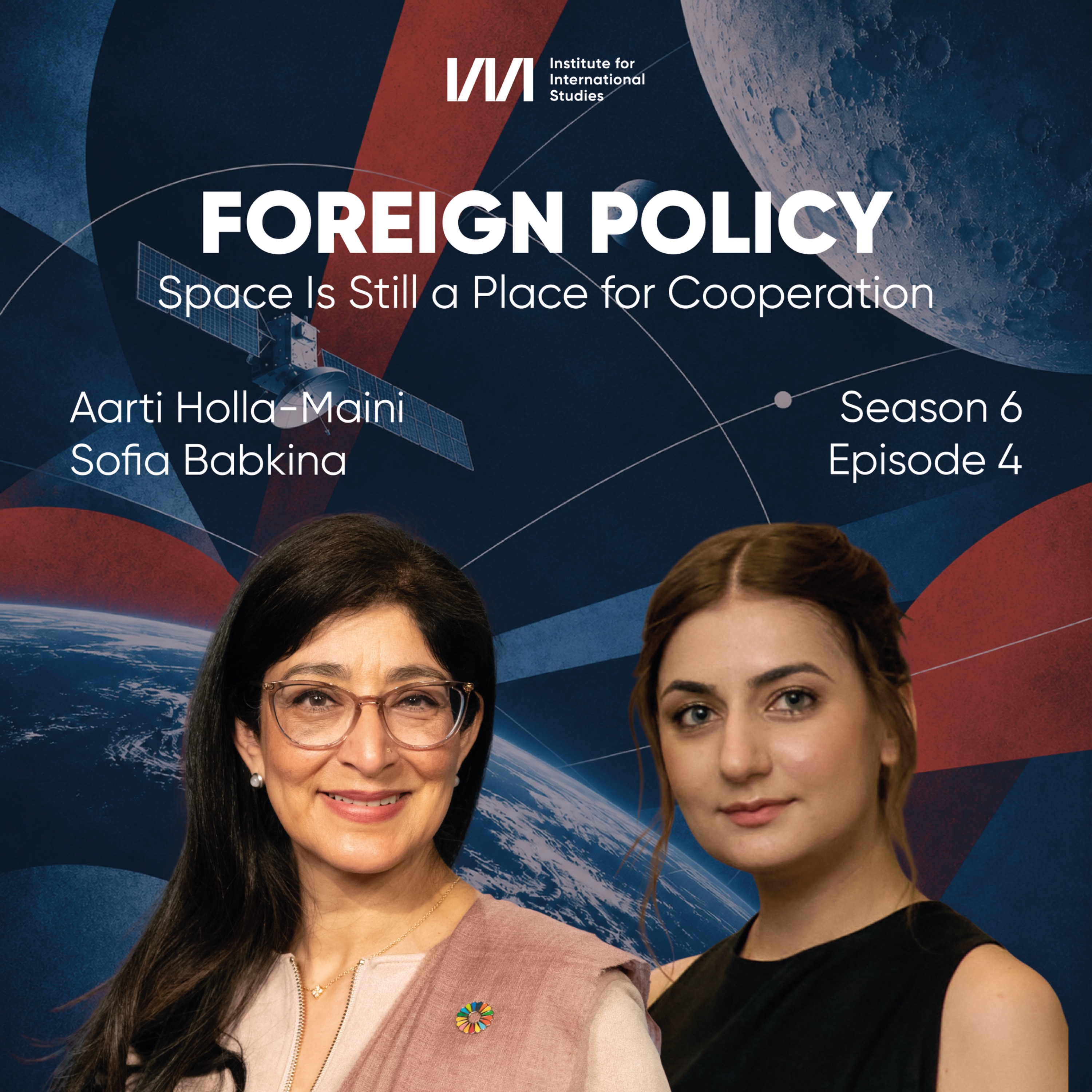
Who makes the rules for activities in outer space? How can countries prevent satellite collisions and coordinate missions to the Moon? And can space diplomacy continue to deliver results in an increasingly divided world?
In this episode of the MGIMO Institute for International Studies' Foreign Policy podcast, Sofia Babkina and Aarti Holla-Maini, Director of the United Nations Office for Outer Space Affairs (UNOOSA), discuss the UN's role in international space cooperation.
They discuss the distinction between space safety and space security, the work of the UN Committee on the Peaceful Uses of Outer Space (COPUOS), and efforts to improve space traffic coordination and the sustainability of lunar activities. The conversation also explores planetary defence, the growing role of commercial space actors, and how satellite data can help countries address challenges on Earth.
Ms Aarti Holla-Maini also shares her priorities for UNOOSA through 2030, advice for students and early-career professionals interested in space diplomacy, and some personal reflections on the history and future of space exploration.
Guest: Ms Aarti Holla-Maini, Director of the United Nations Office for Outer Space Affairs (UNOOSA)
Host: Ms Sofia Babkina, Research Fellow at the MGIMO Institute for International Studies and Editor-in-Chief of the Foreign Policy podcast
Time Stamps:
00:06 Introduction: Aarti Holla-Maini and the UN Office for Outer Space Affairs
01:09 What Does UNOOSA Actually Do?
04:25 Space Safety vs. Space Security: Why the Distinction Matters
06:40 Can Space Diplomacy Work in a Divided World?
07:22 Preventing Satellite Collisions: The UN's Unexpected Role
09:13 Who Will Coordinate Missions to the Moon?
10:35 Planetary Defence: What Happens When an Asteroid Threatens Earth?
12:48 UNOOSA's Priorities for 2030
13:48 How Satellite Data Can Improve Life on Earth
16:23 Private Companies and the Future of Space Governance
17:55 Can Commercial Interests Undermine International Cooperation?
19:23 How to Build a Career in Space Diplomacy
20:58 Why Space Diplomacy Needs More Than Engineers
22:39 Quickfire: Gagarin, the Moon Landing and UN Consensus
23:13 David Attenborough, Space Films and Empathy
24:28 Would the Director of UNOOSA Travel to Space?
The Institute for International Studies (IIS) is a multi-disciplinary research branch of MGIMO University, established in 1976 as the Problem Research Laboratory for System Analysis of International Relations, and last renamed in 2009. We pride ourselves on our history of conducting innovative, in-depth, applied research in IR.